Multimodal fact-checking or multimodal fake news detection? Two communities, one goal
Published:

How much can a difference in terminology lead researchers working on the same real-world problem to form separate communities, with their own methods and datasets? I have been working for the last three years on developing AI methods to assist professional fact-checkers in detecting misinformation that combines text and multimedia content, primarily images. While conducting literature searches or reviewing papers, I observed that several synonyms exist for this task: multimodal fact-checking, multimodal misinformation/fake news/rumor detection, … In practice, these terms describe the same thing. “Fact-checking” refers to the nature of the task, while other terms refer to the object of study. Some terms are preferable to others. For example, the UN recommend using “misinformation” (or “disinformation” when the act is intentional) rather than the more generic and easily misused “fake news” [1]. As we will see later, “fake news” is still sadly the most popular term in research papers. Some terms are more specific. For example, “out-of-context misinformation” (OOC) focuses on authentic images that are presented with misleading captions.
I started to notice that papers using different names for the task also tended to use different benchmarks and methods. Over the years, I became increasingly concerned that our field was splitting into separate communities. To see whether this impression was more than an anecdotal observation, I used the Semantic Scholar API to collect all papers citing a curated list of major datasets and analyze them. I discuss below the main insights.
📖 Glossary
In AI research, a benchmark is a set of input/output pairs used to evaluate and compare methods. In multimodal misinformation detection, the input typically consists of an image and a textual claim, and the primary output is a verdict, usually true or false.
Tell me your task name, I’ll tell you your benchmarks
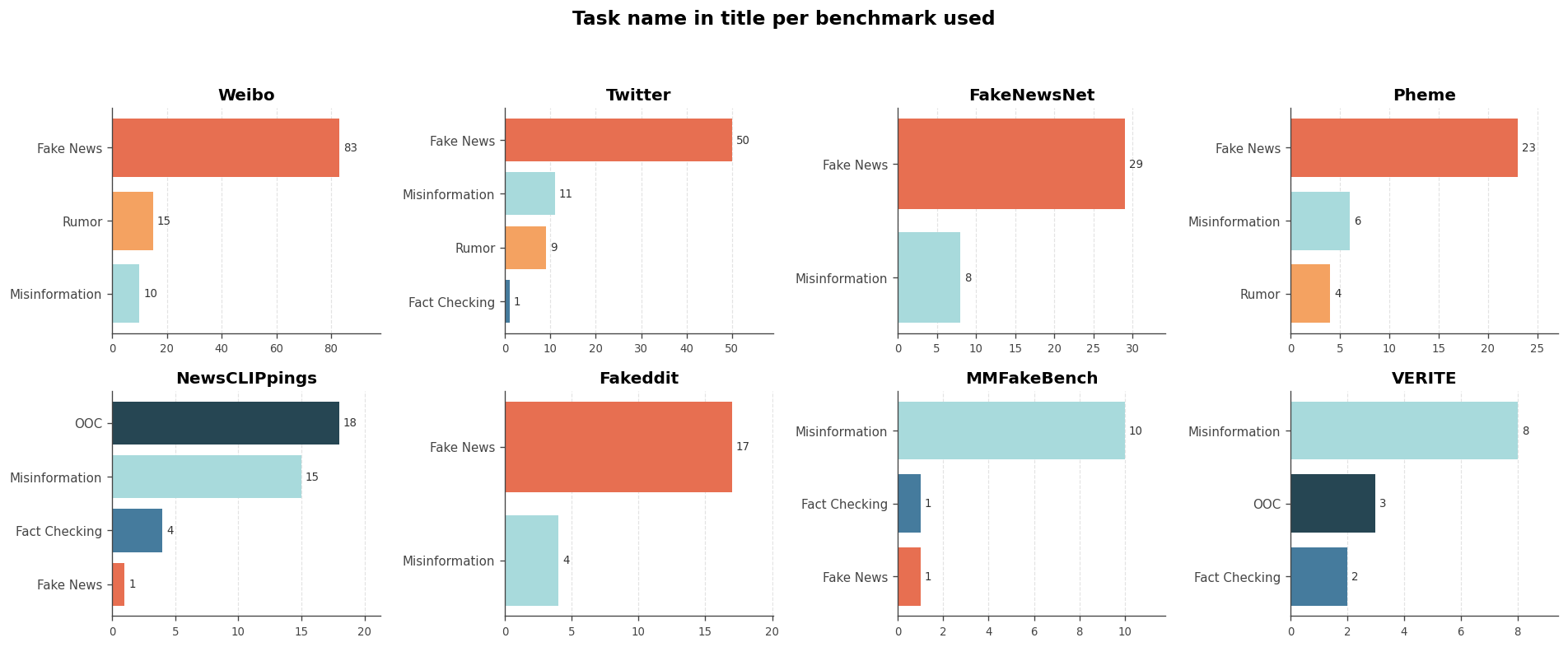
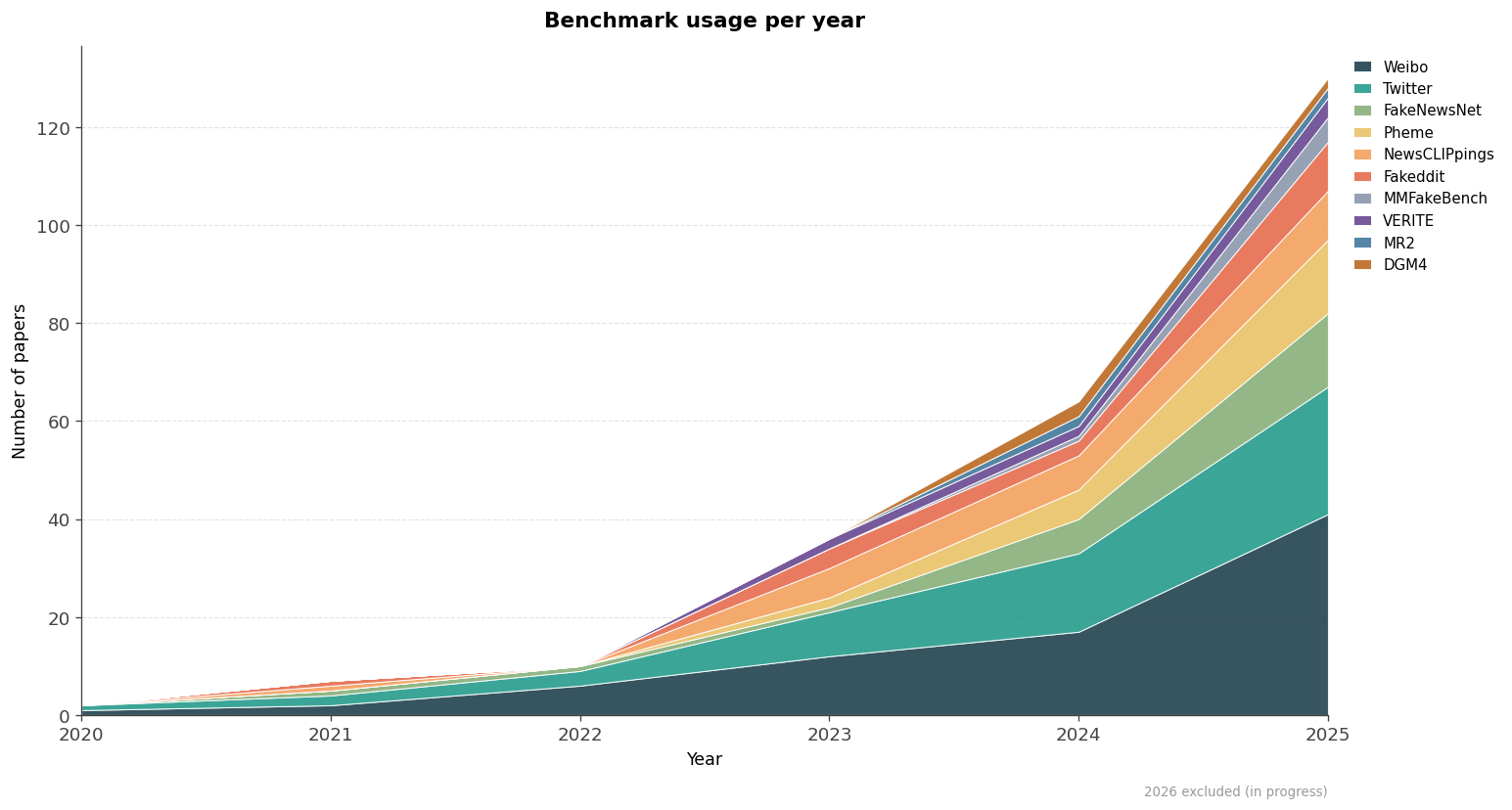
Our initial intuition seems to be correct: different task names are associated with different benchmarks. If one uses the terms “fake news” or “rumor” in the title of their paper, there is a good chance that they will report results on the Weibo, Twitter, or Pheme benchmarks. But if you wrote “fact-checking” or “OOC” in the title, you are likely using NewsCLIPpings or VERITE. Only the term “misinformation” lies in between what appears to be two partially separated communities, one centered around fake news and rumor detection and the other around fact-checking and OOC detection.
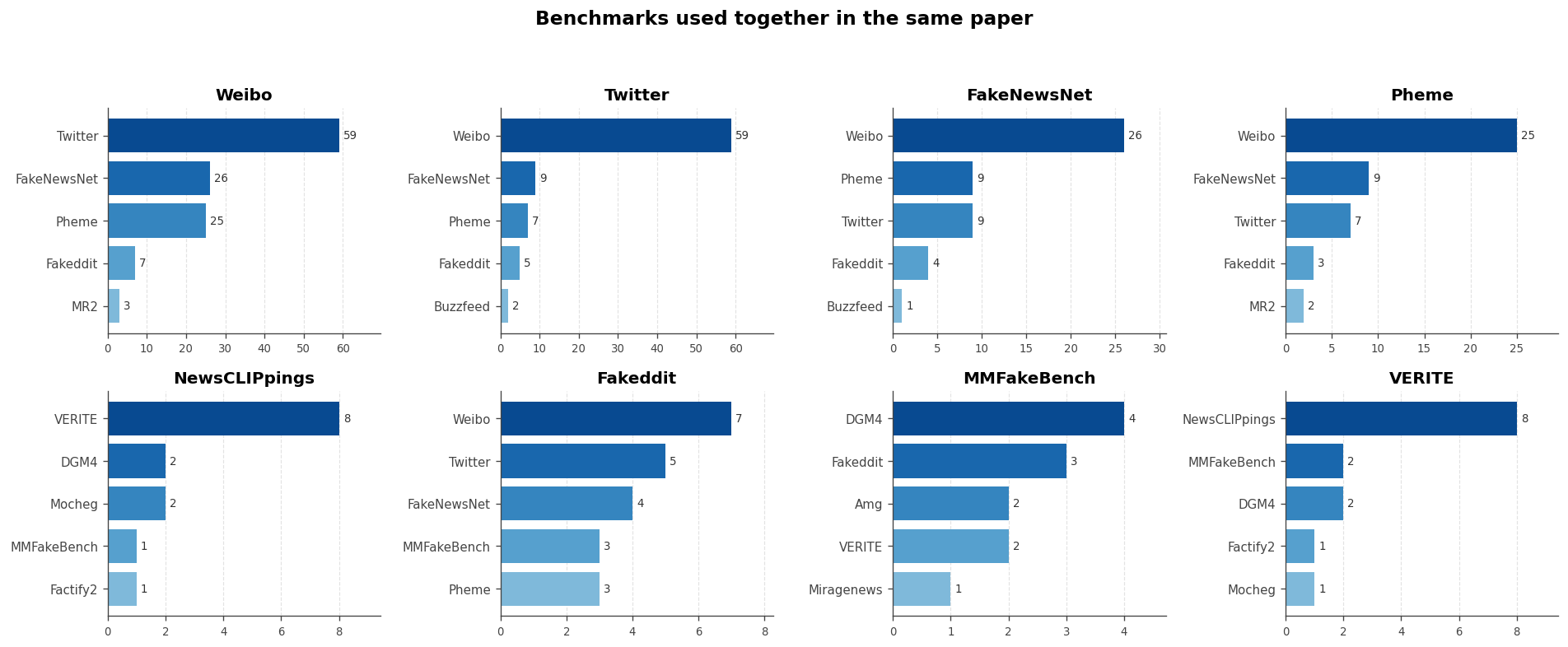
Analyzing which benchmarks are used in combination further supports the presence of two communities. On the one hand, Weibo, Twitter, Fakenewsnet, and Pheme form a cluster. On the other, NewsCLIPpings, VERITE, and the more recent MMFakeBench form another. Only Fakeddit acts as a thin bridge between the two.
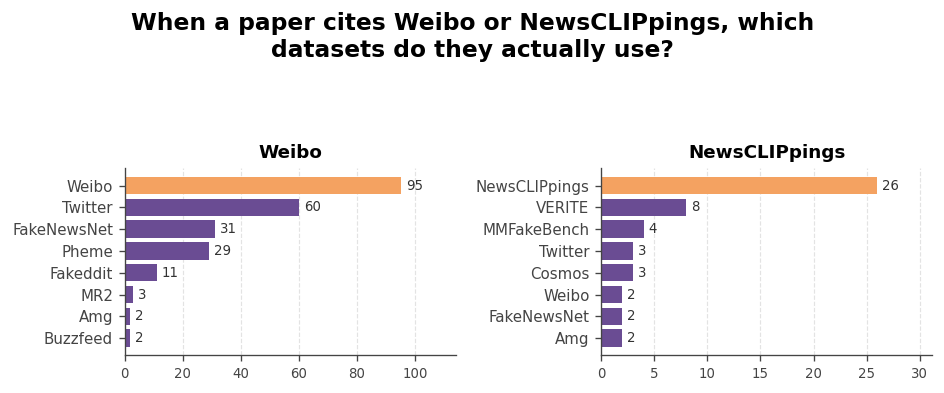
Let’s zoom in on the main benchmarks from each community, NewsCLIPpings and Weibo. When a paper cites them, do they actually use benchmarks from the other community to evaluate new methods? The answer is no. We found no paper in our corpus that cites Weibo and then uses benchmarks of the “multimodal fact-checking” community. The same holds for papers that cite NewsCLIPpings, they very rarely use Weibo, Pheme, or Twitter.
Fake news detection is winning the terminology race, for now
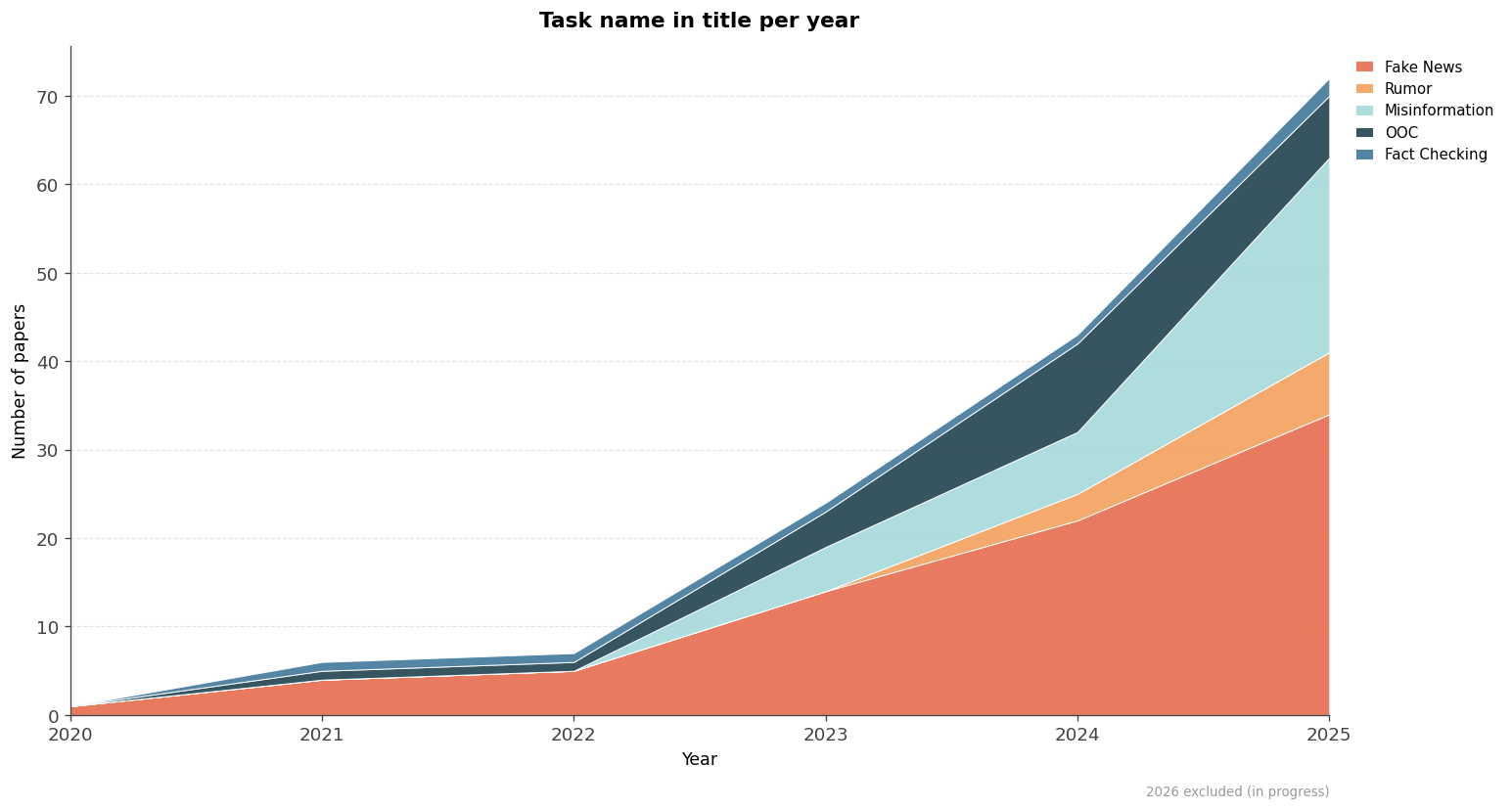
The papers calling the task “multimodal fake news detection” have had a much higher volume of submissions, particularly in recent years. This means that benchmarks such as Weibo (which has several variants released over the years) and Twitter are among the most widely used. In comparison, the “multimodal fact-checking community” represents only a small share of the field. This is unfortunate for three reasons. First, the term “fake news”, discouraged by organizations such as the UN, the WHO, and the EU, continues to be used extensively in research papers. Second, some of the “multiodal fake news detection” benchmarks, such as Weibo, are largely saturated, with reported accuracies above 95%. These benchmarks are also old, 10 years in the case of Pheme. Misinformation detection methods based on large language models (LLMs) cannot be reliably evaluated on such old benchmarks due to the risk that the benchmark was leaked into the LLM’s pre-training data. Third, many methods in the “multimodal fake news detection” community focus on binary classification: is the content true or fake? They often do not provide explanations grounded in external evidence, even though such output is more useful to professional fact-checkers than a simple binary verdict [2].
In contrast, the “multimodal fact-checking” community is better aligned with real-world use cases of professional fact-checkers. In this community, leveraging external information to ground and justify verdicts is nowadays standard practice, and benchmarks are regularly updated and improved to avoid shortcuts and data leakage within LLMs pretraining corpora. At the same time, many methods proposed within the “multimodal fake news detection” community achieve high detection performance on Pheme, Twitter, or Weibo and deserve evaluation on more recent benchmarks from the “multimodal fact-checking” community. After all, the next state-of-the-art might emerge from an encounter between the methods of both communities.
Time to build some bridges
In summary, researchers trying to automate multimodal misinformation detection are currently split across two main communities, with separate benchmarks and partially overlapping methods. Building more bridges between these communities in the coming years could benefit both and, hopefully, eventually bring them entirely together. The “multimodal fake news detection” community would benefit from evaluating its methods on more recent, less saturated, and more robust benchmarks developed by “multimodal fact-checking” researchers, such as AVerImaTeC, M4FC, or VERITAS. Conversely, researchers working on fact-checking could benefit from testing their evidence- and LLM-based approaches against the sophisticated multimodal methods developed for multimodal fake news detection.
📝 Takeaways
- Research on multimodal misinformation is split into two communities that rarely mix: fake news / rumor detection (Weibo, Twitter, Pheme, …) and fact-checking / OOC detection (NewsCLIPpings, VERITE, MMFakeBench, …).
- Fake news detection dominates by paper volume, but leans on old, saturated benchmarks that are risky for evaluating LLMs and focus too much on binary verdict prediction.
- The fact-checking community is smaller but better aligned with real-world fact-checker needs: evidence-grounded verdicts and recent benchmarks.
- Building bridges: cross-evaluating each community’s methods on the other’s benchmarks could push the field forward and eventually reunite it.
Disclaimer: A corpus of around 200 papers was collected from the Semantic Scholar API and manually reviewed for the purpose of this post. The corpus was constructed by following citations to a curated list of major benchmarks and filtering them for the presence of specific keywords in their titles, so it should not be considered a systematic literature review. The analysis is intended to illustrate broad trends rather than provide a comprehensive picture of the field.
Collection method
All papers citing a seed set of popular multimodal misinformation detection benchmarks were collected using the Semantic Scholar API. These benchmarks are: Pheme, Weibo, Twitter, DGM4, VERITE, NewsCLIPpings, MR2, MMFakeBench, AverImaTeC. All articles that contain one of the following terms in their title are collected: fact-checking, misinformation, disinformation, fake news, rumor, out-of-context. The benchmarks used in the experiments section of a paper are manually labeled based on the article’s content. Articles behind a paywall are excluded from the study.
The metadata is available here.
References
[1] Cherilyn Ireton and Julie Posetti. 2018. Journalism, fake news & disinformation: handbook for journalism education and training. Unesco Publishing.
[2] Preslav Nakov, David Corney, Maram Hasanain, Firoj Alam, Tamer Elsayed, Alberto Barrón-Cedeño, Paolo Papotti, Shaden Shaar, Giovanni Da San Martino. 2021. Automated Fact-Checking for Assisting Human Fact-Checkers. IJCAI 2021 Survey Track. Pages 4551-4558. https://doi.org/10.24963/ijcai.2021/619